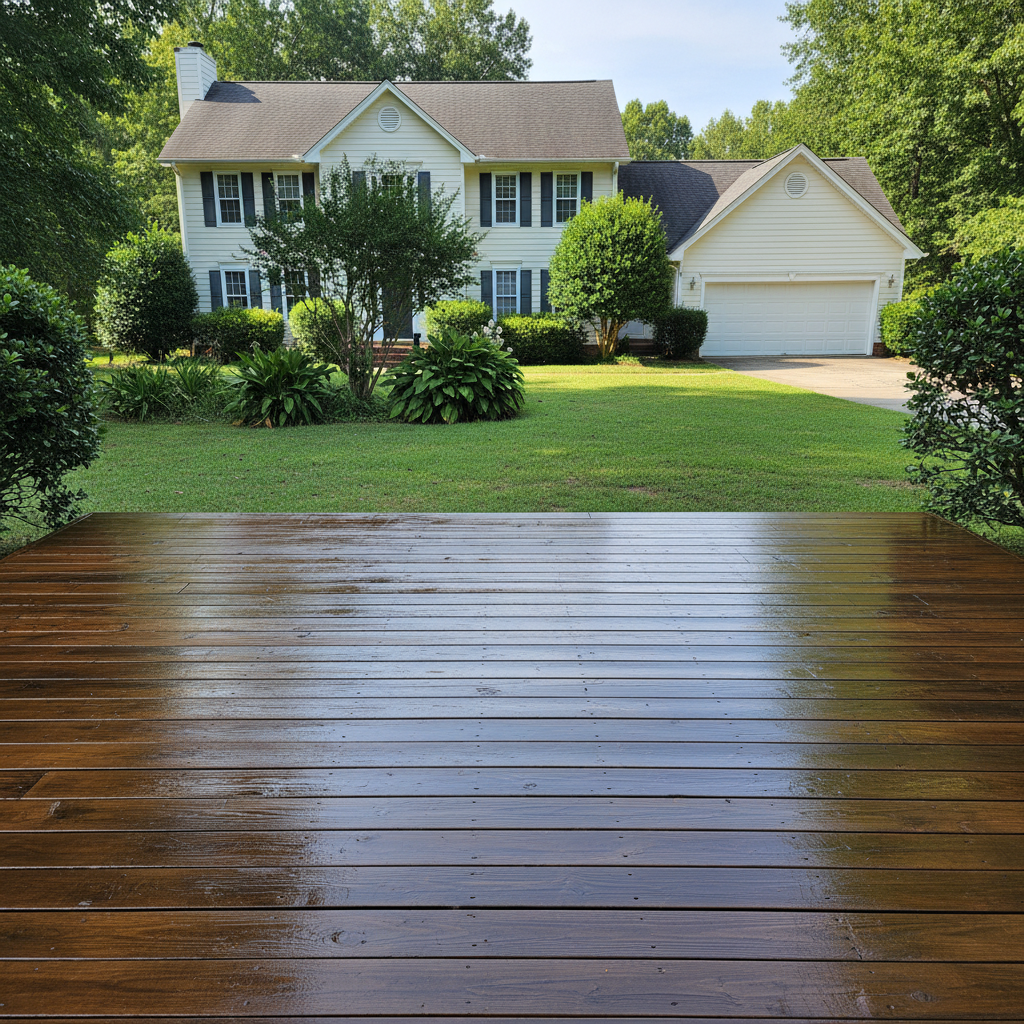
People ask us when to schedule a new deck like it's a simple calendar question. It isn't, because the answer depends on what the ground is doing, what the concrete is doing, and what a sealer needs to cure. In DeSoto County those three things don't all line up in the same month, so the real answer changes depending on whether you're pouring footings, framing, or staining.
Here's how we actually think about it, broken down by what's happening in the ground and in the air.
The clay soil sets the footing schedule, not the calendar
Most lots around Olive Branch sit on red clay that swells when it's wet and shrinks hard when it dries out. That movement is what cracks patios and tilts fence posts, and it's exactly what a deck footing has to get below. Local footing depth typically needs to reach at least 12 inches, below the zone where that clay is doing its seasonal swelling. In a wet spring, that clay can be heavy and sticky enough to slow digging and make a sonotube footing hard to set plumb. In August, the same clay can be dry and cracked at the surface, which actually makes it easier to auger through cleanly.
Concrete itself doesn't love extreme heat either. Poured in 95-degree July weather, footings can cure too fast on the surface while the inside is still soft, which is how you get surface cracking. We like to keep footings wet-cured and shaded for the first 48 hours no matter what month it is, but that's a lot less fuss in October than it is in mid-summer.
Spring rain versus fall dryness
March through May in this part of Mississippi brings the heaviest rain of the year, plus the stretch of severe weather that makes everyone around here watch the sky a little closer. Saturated ground is hard to dig footings in, and a job site that's mud for three days in a row loses time nobody gets back. Framing in that window is doable but you're often working around rain delays.
September through November is usually the calmer stretch. Humidity drops, the ground firms back up, and you get stretches of five or six dry days in a row, which is enough to pour footings, frame, and get a first coat of stain on before weather turns again. If you're planning a full build from the ground up, fall is usually the smoothest window we see all year.
Staining and sealing need a narrow temperature window
This is the part people underestimate. Most penetrating sealers and semi-transparent stains want surface and air temperatures between about 50 and 90 degrees, and they need roughly 24 to 48 hours without rain to cure properly once applied. A new pressure-treated deck also needs 2 to 3 weeks of dry time after installation before it will even accept stain the way it should, since the wood is still carrying a lot of moisture from the treatment process.
That rules out a lot of July and August, where afternoon humidity sits high enough that a stain can stay tacky longer than it should, and it rules out January, where a cold snap can keep surface temps below the cure threshold for days. Late spring and early fall are really the only reliable windows for staining work, which is why we tend to stack those jobs into April-May and September-October rather than mid-summer.
Winter isn't dead time, it's just narrower
Framing and footing work can still happen in December and January here, since the ground rarely freezes deep enough to stop digging, and we don't get the kind of sustained hard freeze that shuts a job site down for weeks. What winter is bad for is finishing work. Stain won't cure right, composite decking can be installed but you're working with stiffer boards and gloved hands, and nobody wants to be up on a ladder hanging railing during an ice event, which does happen here a few times most winters.
If your project is mostly structural, a winter start isn't a bad idea, and it can mean a shorter wait for a contractor's schedule, since late winter is usually slower for us than April is.
Permits and inspections don't move by season, but your wait time can
Deck permits in Olive Branch generally go through the city's building department if you're inside city limits, or through DeSoto County if you're in one of the unincorporated areas nearby. Expect at least a footing inspection before you backfill, and a framing inspection before decking boards go down and hide everything underneath. If your lot is in one of the newer subdivisions with an HOA, like a lot of the growth around Goodman Road and out toward Center Hill, you'll likely need a design submitted for architectural approval before the city permit even gets pulled, which adds time up front no matter what month you start.
Spring is when permit offices tend to get busiest, simply because that's when everyone else is trying to build too. Pulling a permit in late winter or early fall often means a shorter wait just because fewer people are in line ahead of you.
Older decks have their own timing problem
A lot of the decks going up for repair or resurfacing right now were built in the 1990s and early 2000s, when Olive Branch was growing fast and ledger board flashing wasn't always done the way it would be today. Those decks often show rot right where the ledger meets the house, and that's not a job you want to discover mid-summer when the house is full of guests and the grill is out every weekend. Scheduling repair work for early spring, before the heavy-use season starts, means it's done before you need the deck, not after something gives way on it.
If you're weighing a new build, a repair, or just trying to figure out when a screened porch or pergola makes sense given all of this, Heritage Deck Solutions can walk through your specific lot and timeline with you before you commit to a season.